Have you ever come across the word haiku and wondered what it actually means?
Whether you saw it in a school assignment, a social media post, a poetry discussion, or even a meme, understanding the haiku meaning can help you appreciate one of the world’s most famous forms of poetry.
A haiku is much more than just a short poem. It is a unique style of writing that captures emotions, nature, and moments of life using only a few carefully chosen words.
Originating in Japan centuries ago, haiku poetry has become popular worldwide because of its simplicity, creativity, and ability to express deep thoughts in a compact format.
Today, people use haikus in classrooms, writing communities, blogs, social media platforms, and even marketing campaigns.
The beauty of a haiku lies in its ability to create vivid imagery while remaining brief and easy to read.
What Does Haiku Mean?
A haiku is a traditional Japanese poem consisting of three lines that typically follow a 5-7-5 syllable pattern.
The basic structure is:
- First line: 5 syllables
- Second line: 7 syllables
- Third line: 5 syllables
Haikus are usually inspired by:
- Nature
- Seasons
- Human emotions
- Everyday experiences
- Moments of reflection
Simple Definition
A haiku is a short poem designed to capture a single moment, feeling, or image in a concise and meaningful way.
Example of a Haiku
Old silent pond waits
A frog jumps into the water
Splash echoes softly
This poem creates a vivid image using only a few words.
Origin of Haiku
The haiku originated in Japan during the 17th century. It evolved from an older poetic form called “renga,” a collaborative linked-verse poem.
One of the most influential haiku poets was Matsuo Bashō, who helped establish haiku as a respected literary form.
Historical Timeline
Early Origins
- Developed from Japanese linked poetry.
- Focused on seasonal themes.
17th Century Growth
- Bashō popularized haiku.
- Nature became a central subject.
Modern Expansion
- Haiku spread worldwide.
- Writers adapted it into different languages.
Today, haiku poetry is practiced by millions of people across the globe.
Why Are Haikus So Popular?
Haikus remain popular because they are:
- Short and easy to read
- Creative and expressive
- Suitable for beginners
- Perfect for social media sharing
- Effective for capturing emotions
Many people enjoy writing haikus because they encourage mindfulness and observation.
Benefits of Reading and Writing Haikus
- Improves creativity
- Enhances vocabulary
- Encourages concise writing
- Helps develop observation skills
- Promotes emotional expression
How to Use Haiku in Texts or Chat
Although haikus are traditionally poems, modern internet users often create haiku-style messages for fun.
Common Places Where Haikus Appear
- Text messages
- Social media posts
- Reddit discussions
- Online writing communities
- Classroom assignments
- Poetry contests
Example in a Chat
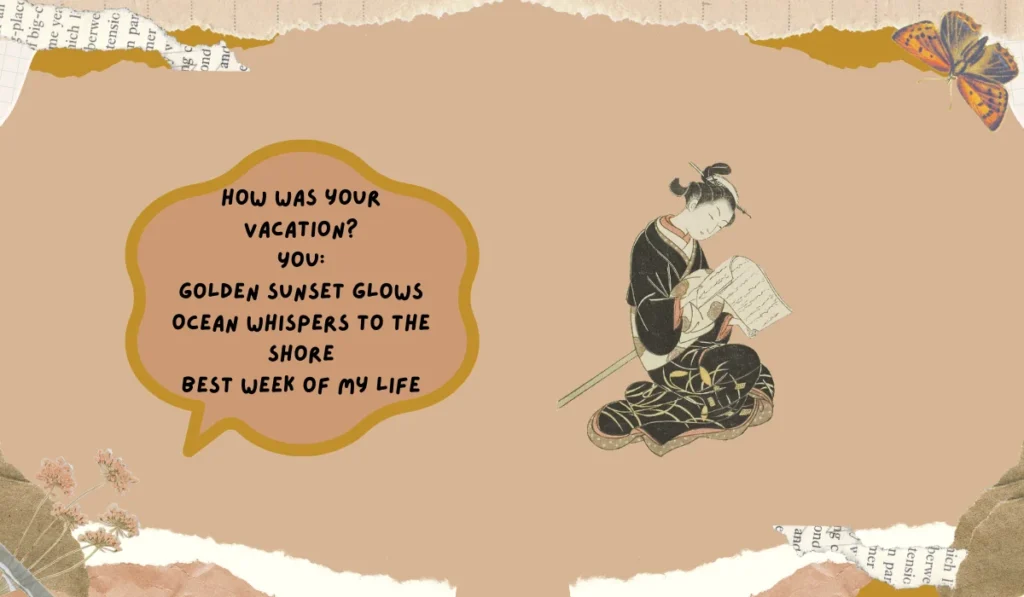
Friend: How was your vacation?
You:
Golden sunset glows
Ocean whispers to the shore
Best week of my life
This playful response uses a haiku format instead of a regular sentence.
Structure of a Traditional Haiku
Understanding the structure is essential.
Line One
Contains 5 syllables.
Example:
Morning sunlight shines
Line Two
Contains 7 syllables.
Example:
Birds sing softly in the trees
Line Three
Contains 5 syllables.
Example:
Spring awakens all
Complete Haiku
Morning sunlight shines
Birds sing softly in the trees
Spring awakens all
Examples of Haiku in Conversations
Example 1: About Work
Coffee fuels my day
Emails keep arriving fast
Weekend come quickly
Example 2: About School
Books stacked on my desk
Homework fills another night
Summer feels far away
Example 3: About Weather
Rain taps on windows
Dark clouds drift across the sky
Fresh air follows soon
Example 4: Funny Haiku
Phone battery low
Charger nowhere to be found
Panic mode begins
These examples show how haikus can be serious, reflective, or humorous.
How to Write Your Own Haiku
Creating a haiku is easier than many people think.
Step 1: Choose a Topic
Popular topics include:
- Nature
- Seasons
- Friendship
- Love
- Travel
- Daily life
Step 2: Focus on One Moment
Avoid trying to tell a long story.
Instead, capture:
- A feeling
- A scene
- An observation
Step 3: Follow the Syllable Pattern
Use:
- 5 syllables
- 7 syllables
- 5 syllables
Step 4: Use Descriptive Language
Paint a picture with words.
Example:
Snowflakes gently fall
Blanketing the silent streets
Winter dreams begin
Common Mistakes or Misunderstandings
Many beginners misunderstand the haiku format.
Mistake #1: Ignoring Syllables
A traditional haiku follows the 5-7-5 structure.
Mistake #2: Writing Too Much
Haikus should be concise and focused.
Mistake #3: Explaining Instead of Showing
Instead of saying:
“I feel happy today.”
Try:
Warm sunlight appears
Flowers bloom beside the path
Smiles come naturally
Mistake #4: Using Multiple Topics
Stick to one image or idea.
Haiku Meaning in Modern Culture
The meaning of haiku has evolved beyond traditional poetry.
Today, people use haikus:
- On Instagram captions
- In creative writing challenges
- In educational activities
- In marketing campaigns
- As humorous internet content
Modern writers often experiment with the format while preserving its spirit of simplicity.
Related Slangs or Abbreviations
Although haiku is not a slang term, people searching for language meanings may also be interested in:
- LOL – Laugh Out Loud
- BRB – Be Right Back
- IMO – In My Opinion
- TBH – To Be Honest
- SMH – Shaking My Head
- WSG – What’s Good?
- FYP – For You Page
- ICYMI – In Case You Missed It
Internal Linking Suggestions
You may link this article to:
- LOL Meaning
- TBH Meaning
- WSG Meaning
- SMH Meaning
- FYP Meaning
- Internet Slang Dictionary
Haiku Examples for Beginners
Nature Haiku
Leaves drift in the wind
Autumn colors paint the hills
Nature slows its pace
Friendship Haiku
Laughter fills the air
Good friends brighten every day
Memories remain
Technology Haiku
Notifications
Constantly light up my screen
Peace feels hard to find
Travel Haiku
Mountain peaks appear
Adventure waits beyond them
Journey starts today
FAQs
Is a haiku always 5-7-5?
Traditional haikus generally follow the 5-7-5 syllable pattern, though some modern versions are more flexible.
Does a haiku have to rhyme?
No. Haikus do not require rhyming words.
What is the main purpose of a haiku?
To capture a moment, feeling, or image in a brief and meaningful way.
Can kids write haikus?
Yes. Haikus are often taught in schools because they are simple and creative.
Are haikus still popular in 2026?
Absolutely. Haikus continue to be widely used in education, social media, and creative writing communities.
Conclusion
Understanding the haiku meaning is simple once you know its purpose.
A haiku is a short Japanese poem that traditionally follows a 5-7-5 syllable structure and captures a single moment, emotion, or image. Its simplicity makes it one of the most beloved forms of poetry worldwide.
Whether you’re a student, writer, teacher, or simply curious about language, haikus offer a creative way to express ideas with very few words.
Their timeless appeal continues to inspire readers and writers across generations.
Updated for 2026, this guide covered the meaning, origin, structure, examples, and practical uses of haikus.
Share your favorite text abbreviation or haiku in the comments and inspire others with your creativity!